Friday, April 18, 2008

The One Lesson Every Webcomic Creator Must Learn

First off, a confession: Webcomics make me sick.

Actually, let me rephrase that. I like having a webcomic, drawing a webcomic, starting a fandom for it, bringing my characters to life . . . so in actuality, my webcomic keeps me healthy. It's the way other people treat their webcomics that makes me sick, makes me want to stop reading, makes me furious for ever liking their comic to begin with... and believe it or not, it makes me even MORE upset than the average reader of such a comic, because it makes my job that much more difficult.

So, please, if you have a comic . . . for my sake and everyone else's, learn this:

Respect.
Your.
Readers.

This is not optional. If you want to stand ANY chance of going anywhere in webcomics -- and I don't care if anywhere is becoming DC/Marvel's lapdog, or printing your book, or even just making a little money on the side -- you need to learn this.

Ask any fan of webcomics, and they all have a story about how they were "burned" by less scrupulous artists: either their idols were a little too rude to a fan or three at a convention, online drama erupted that somehow managed to become part of the folklore of the site, they slowed down to the point nobody knew when the story was going to pick up again, or even (God Forbid!) they stopped working on the comic just before the story was about to end.

Yes, creating content about your stories, crafting beautiful panels and imagery, organizing your website for appropriate content . . . this is all important, perhaps even necessary. In spite of this, so many people seem to forget that starting a comic (especially one that contains a story) is supposed to be a general contract between an artist that they will do what they can to tell the story, and in turn readers will reward the artist for this with patronage and profits. Stop the story before it's done (or before you can at least bring it to a satisfying conclusion), you break the contract. Give people what they wanted all along, and you'll be a hero for it.

Difficult? Sure . . . but at the same time, for every person who makes a great-looking comic they can't continue, there's an artist struggling against this stereotype that webcomics are not "serious" ventures -- that they're made to be abandoned as soon as the artist lands a real job / turns sixteen / loses their virginity. I can't tell you how many times people have told me they're so shocked that a once-a-week comic could actually captivate and keep them panting for the next page just like a daily comic . . .

. . . and this is without including the fact my father told me over lunch at MomoCon how impressed he was with what I was doing, since most comics that fail tend to crap out around the hundred-strip point.

Yes, I know I'm only up to 80 pages right now, but it only underscores how ridiculously low the bar is set for webcomics.

(EDIT: As of July 8, 2008, I'm about to reach the hundred-strip point, and I'm starting to see WHY folks crap out. Yeesh.)

It's not my fault that people have these expectations about webcomics and are shocked to find a comic where, somehow, it manages to do simple things like help the reader find all the information they want, updates when it says it does, and god forbid, doesn't insult the reader's intelligence. And as much as I would be justified naming a few especially bad examples of this, even among popular, "successful" webcomics . . . if there's one thing I actually find relevant from reading about people like Judith Butler in class, it's that expectations like this come from only one thing: sedimentation.

(And yes, I'm as shocked as you are that I somehow managed to relate a feminist philosopher to a rant about webcomics. My apologies. I'll try harder in the future not to drag my schoolwork into the blog.)

One thing stacks on top of everything else and continues ad infinitum until it becomes accepted. Every Dead Piro Day, every Guest Comic, every Filler update, every "I swear I'll update in a few weeks!" post . . . it all adds up to this expectation that webcomics are unreliable, and damn it, sooner or later everyone decides this is just how webcomics work.

The only way to fix it is to start becoming reliable, and realizing that if you expect to survive off the generosity of others, you damn well better give them something for it. Maybe not necessarily what they want (though it helps), but at least what you say you'll give 'em. Of course, there's more than reliability involved, but it's far and away the most obvious show of respect. The next trick, of course, is how to make it clear to new readers that you have their best interests at heart too.

If you're willing to do what you can to help, I don't have all the answers up yet (though here are some steps in the right direction), but that's easily fixed with a little bit of time... and a subscription to the RSS feed, if you're not already on it.

You owe it to yourself. You owe it to your readers. You don't have to put them before your own health or anything crazy; but you do have to remember that they're here for you because you offer them something special.

Don't blow it.

Labels: , , , , , ,

Sunday, February 24, 2008

Free Commission Available - Seriously!

Guess who's feeling generous today? Me, that's who!

I feel like giving out some art to some lucky Last Resort reader. In fact, the first person to email me with White Noise's full name wins a full-body commission, absolutely FREE.

It's already in the archives, so it's not a huge secret. Just a simple way to make sure people are paying attention. Two minutes work could net you an awesome piece of art.

So what're you waiting for? Go get it!

Labels: , , , ,

Tuesday, February 12, 2008

Positioning Statements - Target or Die!

Comics need readers. Readers are brought in by, among other things, good advertising. This tends to require that the makers of those comics make their own advertising, and just like there are bad webcomics, there can be worse advertising for these comics. Fortunately, good advertising doesn't require big focus groups and research (at least not all the time) -- sometimes you can get away with using a tiny guideline called a positioning statement.

Positioning Statements are little blurbs of text that sound fairly useless at first -- perhaps even amazingly obvious -- but they allow you to understand who your audience is, what makes your stuff stand out, and if you're really struggling to come up with a good ad to use, this can help give you a bellwether to gauge its effectiveness by. (At this point it should go without saying that if you're paying for space on Project Wonderful without having something like this, you're probably wasting money on an ineffective ad!) For something that your average reader will probably never see, it's still incredibly important to have.

It may take a little bit of time to write the statement itself, but they all tend to follow the same sort of structure. This site has a straightforward plug-and-play version that you can go and tweak for your own purposes:
For [whoever's cash/attention we're after] that wants [some quality people demand], [Our Product/Service/Brand] is a [product category] that has [a benefit tied to the quality people demand].

Unlike [whoever we're trying to grind underfoot], [Our Product/Service/Brand] has [this trait that makes us better than them].
Now, you can rewrite that statement to sound a little less aggressive, but the idea is there. What you fill in the blanks with says a LOT about what you need to do. Heck, just to show that I have half a clue what writing such a statement will do, let's try it out with our favorite guinea pig, Last Resort:
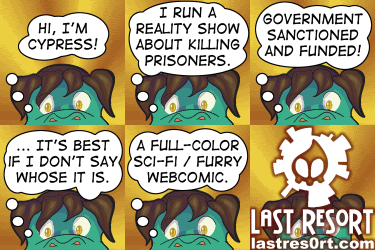
For science fantasy enthusiasts who love engrossing stories of crime and redemption, Last Resort is a webcomic that has a rich galaxy of characters, excellent writing, and action-packed excitement. Unlike most other webcomics, Last Resort makes sure to update on time every week, so you never show up to find disappointing 'filler'.
Sounds pretty awesome, right? Well guess what we just did:
  • We now know who to aim our sights on: Sci-fi/Fantasy folk (i.e. Dragon*Con Fodder)
  • We also know what to hype in the comic:
    • High-Quality Writing / Storytelling
    • Reliability in Updates
  • We can put those two together to make better targeted ads!
See? Mad Libs can be educational after all! The other things we mentioned (like our competition) are useful to know, but really, that's just so we know who to compare our egos against. Simply naming competition isn't good enough unless you know what makes you different from them; and if you can't come up with a good reason why what you're doing is different from everyone else's, there's no reason for anyone else to stop using their product to invest time, energy, and money into yours.

And yes, even when that product is a 'free' webcomic, people's attention spans are still valuable enough to them that if they're already reading 20+ webcomics a day, there's a good chance they might not have time for yours. If it has a 100+ strip archive that people need to read before they can understand what's going on, they might be even more hesitant because reading that archive is an investment of time.

Targeting solves a lot of problems; most people (artists, especially) get caught up in the product, wondering why nobody's noticing them on a giant website like DeviantArt or DrunkDuck, when in fact that's exactly why they're not getting noticed; the potential number of people to reach is just too big to be effective. With targeting, however, you can take a website like Project Wonderful and start running campaigns on very specific websites that have certain keywords, so you waste less money on ineffective advertising.

Still curious about how to make better advertising? Subscribing to the RSS feed will make sure you don't miss the next useful article. If you're having trouble coming up with a good statement, how about leaving a comment with your own ideas and attempts?

Labels: , , , ,

Saturday, January 19, 2008

One Simple Way to Generate More Money out of Project Wonderful (AKA "Why My Ads Started Getting Better")

Freshman Quad, January 19, 2008. Doesn't really have a whole lot of appeal, does it?

Sure, we kinda know what it is — probably a school space (or near a school space) of some kind, and a date. A fairly recent date. Interesting if we already had a bit of a clue, perhaps... but to the average person, it's still pretty mundane.

Freshman Quad, January 19, 2008 - Rare Snowfall at the Atlanta campus. Now this . . . we're getting somewhere. We know there's snow, in a place that doesn't normally get it. Hell, maybe people in the general area will be interested enough to see, now that they have information they didn't before.

Seem simple? Because it is.

I mention this in regards to Project Wonderful (as opposed to say, search engines like Google) because unlike most search engines / directories, most advertisers on Project Wonderful only see a few stats about your available advertising — what your stats are, what your space usually goes for, and the title of your site. Mebbe also a quick usericon that has a sample of your art, if it's worthwhile. Sure, maybe some advertisers (especially if they plan on dumping potentially hundreds of dollars into your site!) will look more closely, but not all. That makes your title one of the few things you can control regarding how advertisers view your site, and also one of the most important to get right.

The more information you have in there that seems worth having, the more it matters. In my own case, merely changing the visible title for those ad blocks from "Last Resort" to "Last Resort - Science Fiction Furry Comic" made a huge difference; by the very next day, I was seeing bids jump from 1 or 2 cents a day to THIRTY cents. Granted, I had also reduced the number of ads available on the site from two to one, so at least part of that could be due to
tightening up the purse strings, but they've been doing exceptionally well since. Also, on the blog page (which had a similar renaming on PW), prices did a similar jump there as well.

Granted, it assumes you know what you need to say to get people interested, but if you already have the site, why not give it a title that makes sure people know what you're about?

Have a better idea? Think I could possibly add something more appealing to my suggestions? Let me know!

Labels: , , , ,

Friday, December 28, 2007

Gaming Project Wonderful: Fewer Ads, Bidding Nothing Makes You More Money

When Project Wonderful first came out and approached the webcomic communities, people thought the new "Infinite Auction" model would revolutionize advertising as we know it. Finally, everyone thought, people would get paid what they were worth! Of course, nobody realized what "they were worth" actually meant.

Make no mistake, Project Wonderful is a clever system, and it's certainly more entertaining (and easier) to become an advertiser on there than ever before. The problem is that (like most advertising media), Project Wonderful is working in the Advertiser's favor, so it's up to the publishers to do everything they can to make sure their properties make as much as they can. Fortunately, it's easy to be both, and there's only a few things that need to be done to get the best results possible, to beat Project Wonderful:
  1. Comb the Freebies. Sometimes bids go for $0.00 (as in absolutely free), and believe it or not, these things will allow you to use completely free advertising. By bidding on these, you force paying customers to pony up (which does at least a little good for the people offering the space, as even 1 cent of profit is better than making absolutely nothing), and/or you get some free airtime, which drives new traffic to the site and improves your own statistics (see below). Remember, you can only make a zero bid for two days at a time, and even if someone else already had a $0 bid on the slot, that just means that you can either force them to pay, or you'll get the spot once their two days runs out.

    The best way to do this is to use Firefox to access PW, search for a specific size ad, and target the ads with a $0.00 current bid and no minimum; then open up a huge number of tabs to bid on those zero-spaces once you've pulled out a good number to bid on. At least 25% of those will likely result in immediate high bids. Even if they're on lousy sites, it's exposure nontheless, and it's also an easy way to test out similar ads against each other (which allows you to E.A.T. on your ads prior to actually laying out some cash!)

  2. Don't Be Picky. Waiting for a publisher to accept your ad is a drag, and likewise, you're missing out on money from each and every ad you do accept, because you get credited every 30 minutes! Even if you like one ad over another, keep in mind that everyone else's bids drive up the price of the one getting the top slot right now, so being picky is in nobody's best interest.

    Why? Because EVERY BID BUILDS ON THE OTHERS. Here's a quick demonstration of a typical bidding scenario on a single ad space:

    • Bidder A is willing to pay $1 on the space, but nobody else wants it. Even though A could pay, it is an unconstested bid, so A gets the slot for free, and the publisher gets no money even though A is willing to pay $1.
    • Bidder B comes along with a $0.00 bid, since he's looking for free advertising. Suddenly there are more bidders than spaces available, so bidding begins to come into play. Even though B is freeloading, it's still an active bid, and so A is finally forced to pay (it's only a cent, sure, but that's better than nothing!).
    • Bidder C comes along and bids $0.05. Now A has to pay $0.06 in order to keep C from claiming the space.

    In other words, the only way you get A to actually pay $1 is if someone bids up to $0.90 on the same slot at the same time. This is great for advertisers because it ensures they never pay more than they want to, but the only way publishers (i.e. you) get to see these huge returns is if a bidding war actually starts. Also, it means you shouldn't discourage smaller bidders, because their presence forces bidding wars and gets higher-paying advertisers to shell out more money. Bidders will often pull out when they realize they're being outbid, which is a pain in the ass in and of itself when you're counting on certain bidders to keep your prices high, so don't help the process along unless there's something REALLY wrong with a higher-rated ad than you're comfortable with.

    The best way to encourage bidding wars is to keep the number of ads available at any given time down to begin with, and that means showing the largest ads you can for a given space. Larger ads pay better (Note how the Skyscraper ad on the blog tends to outperform the banner ads on Last Resort's front page, even though the blog receives only a fraction of the traffic), and the more spaces you have, the more people you need to even be interested in advertising there to make a single cent (once again, the ads only start paying off when you have more bidders than available slots!).

  3. Expect Logarithmic Returns on Traffic. Put bluntly, there are a lot of sites with very little traffic, and very few sites that get a lot of traffic. As you accrue more traffic, you should receive exponentially higher bids for that traffic because you are now competing with fewer and fewer sites that have the same level of traffic.

    This gets back to the initial problem again of furthering your exposure, but it also means that when you start to see an improvement in ads, it also means you're getting more/better traffic as well.
Keep in mind that Project Wonderful should not be your only source of income; while more consistent than donations, it can be incredibly hard to see worthwhile returns when starting out. The good news is that Project Wonderful can run alongside Google Adsense (Google's restrictions apply only to content-based ads; Project Wonderful doesn't care about content!) , and it can provide a new set of statistics for you to keep track of, giving you a better sense of where to put your ads (and also how to further improve your advertising gain!)

And when you realize how easy that can be, it's just wonderful.

Labels: , , , , , , , , , , ,

Saturday, December 22, 2007

Merry Christmas (and don't forget to check in for next week's bonus!)

Been getting busy for the new year, which apparently includes not only making sure enough comic pages get made in time to make sure they don't conflict with the school year, but also some special detours to help people find out about Last Resort.

I have plans to show up at Furry Weekend Atlanta in February (hopefully with a table of some kind, but either way I plan on being there!), along with MomoCon in March, and a few dedicated fans are even trying to talk me into AnthroCon (up in Pittsburgh!) for the summer months. Plans for other conventions are in the works, but these are the ones on my mind right now.

Of course, in order to make these worthwhile, there ought to be merchandise to sell and things for me to do there as well... I plan on offering some commissions, but I'm always open to ideas.

The ads from Project Wonderful are... well... a little maddening to keep track of all the time. They ought to start paying off soon, though.

In the meantime, we have plenty more Last Resort to bring you, so don't forget to say hello in the site's forums (Hosted at the Clockwork Mansion) and to check in on Wednesday (Boxing Day) for the second bonus update!

See you again soon!

Labels: , , , , , , ,

Wednesday, December 12, 2007

An Admission

Somewhere in between trying to glean some sort of clue from CopyBlogger, following GapingVoid, combing my stats on Google Analytics and trying to figure out how to make more than a few pennies a day on Project Wonderful, it hits me that I have no clue what I'm doing. This is a little more significant than it sounds, especially considering that I'm admitting it on a blog where I claim to talk about how to make a comic bigger, better, and God forbid, profitable.

The truth is, whether I care to admit it or not, is that if I had a clue what I was doing and wasn't merely just parroting what I've heard several times over from Blog A and Convention B, I might be doing a little better than I am now. The keyword is "might", as I have a better understanding for the amount of time one has to invest in a webcomic before people actually start reading, but at the same time I know this is a certain level of arrogance. It takes time, sure, but that doesn't mean there aren't short-circuits to the process. However naive I may be about my own chances of success, I know that merely "doing it for myself first" and other suicide notes of the starving artist are not enough.

The approach of the blog has been a little different than that of the comic, and perhaps that's a mistake. Reading my random thoughts aimed for someone who knows less than I do isn't interesting to the average reader of Last Resort, and believe me, I can tell. Just because I can figure out how to somehow make my blog read more like something I find on one of those "how to blog" blogs because I somehow think that because I like reading the things, that regurgitating it with a focus on webcomics somehow makes it more special doesn't necessarily mean it WORKS.

Sure, the idea is pretty straightforward — show how to run a webcomic with some of the tricks that bloggers have used for a while, sound halfway intelligent, and get some ancillary karma out of the deal — but the truth is that while I'm still learning a lot of this, anyone who already wants to think like this is either already going to the source or doing it better, and anyone who doesn't know better probably doesn't even know where to find this.

So . . . maybe it's time to change things up a little. I don't think I'll totally hold my tongue about stuff that sounds like good ideas, but I might hold my tongue on some of it, at least until I get the blogger-jargon taste out of my mouth for a couple days first.

Labels: , , , , ,

Friday, June 15, 2007

"Top 10 Ways to Make your Comic Successful"

... or more importantly, why such things are a crock of [insert favorite word for excrement here].

Yes, I will admit this is self-zinging, because I'm writing a blog on how to make your comic big and yet I'm insulting other people posting about . . . you guessed it, how to make your comic big. It's not that I'm trying to cut down on the competition (though I'd be a fool not to admit I'd like being ahead of the pack).

It's that I'm sick of reading poor excuses for "Do this and suddenly your comic will rock". We all tend to know, instinctively, which ways work and others don't; unless we're incredibly new and naive as to how advertising works, they don't often say anything you don't already know, have tried, and have chiseled at enough to know it's either taking a lot of work a certain way, or like enough to try elsewhere.

Here's a hint: The real tricks that work are the same ones that worked on you when it came to other people's comics.

Your audience, whether you want to admit it or not, is just as smart as (if not smarter than) you, and so anything less is insulting to them. If you notice a certain trick working on you, then you should emulate the same tricks that lured you into reading someone else's comic and adopt them for yourself. Fortunately, this has the advantage of making emulation not just easy, but also proven through your own experience.

The next reason I tend not to like the Laundry Lists of Making Comics Successful is that it assumes all comics are the same sort of material, aimed to the same sort of audience, with the same sort of skew. All other things being equal, it's asinine to think that by doing the exact same thing as everyone else is going to put you AHEAD of everyone else. You're just playing catch-up at this point.

Besides that, if the person giving the advice knew anything of what he was talking about, he wouldn't be telling it to you as a way to get more attention for himself, which (admittedly) most blogs about this sort of niche all have at the heart of things. At least in reading my work, I freely admit I have no clue what's going to make or break me, and by the time I get there, this blog will have already detailed the real tricks involved.

And when I say the 'Real Tricks', I mean I'm not going to tell you to go to site A and register yourself because it worked for me. Here's a quick stab at my own top 10:
  1. Doing things the way everyone else does them only puts you as far ahead as everyone else.
  2. There's thousands of webcomics. Make sure yours is different enough to get anywhere.
  3. Leeching off of other comics' readerships will only get you so far, but at least it's a start.
  4. Expect to be struggling at it for at least a year. Even on the Internet, cults take time.
  5. If you can't be regular, neither can your readers.
  6. Most of the people you're advertising to already read comics. There's far more people in the world who don't. Try advertising to them instead.
  7. Beware the Family-Friendly label (unless you're really really good at it).
  8. Your Comic doesn't have a blog. Your Comic IS a blog. Treat it like one.
  9. Eventually, advertising comics is like advertising anything else.
  10. You are vying for people's attention spans. Your competition, therefore, is everything else in the world. Start digging the trenches now.
Note the lack of "Go to these sites and fill out these forums." That's cause these are the keys themselves; once you realize why these statements are all true, you can start aiming your crosshairs better.

More to the point, once I realize why they're all true, I can stop ranting about everyone else's bad aim.

Labels: , , ,

Thursday, June 14, 2007

Five Tips for Selling Yourself First

Online, an artist is only as good (or as bad) as their reputation. Some key concepts:

1. People don't just want an artist anymore. They want a friend.
Make yourself available. Chill in other comics' forums. For the first few months of your comic's existance, resign yourself to the idea that you're going to be leaching off of other established artist's groups, because quite frankly if you know how to reach any other audience you'd be writing a blog like this one. It may seem counter-intuitive and vaguely insulting, but for what it's worth, it's a lot cheaper than most other advertising routes open to you.

Don't worry about spreading yourself thin; Even if all you do is make a few high-profile posts on a forum, it's probably gotten you some decent legwork done, and that's umpteen more people that know about the comic when they wouldn't have otherwise.

2. They want you to spend some time on them personally.
If you're too busy to talk, your would-be-fans are too enamoured with other people to pay attention to you. Also, let's face it; you're drawing a WEBCOMIC. You have time to burn.

There's a few ways to accomplish this, and either it involves some "Author's Notes/Blog" type comics where you speak directly to the readers using the strip, or you keep a separate blog/LJ as a supplement to the comic. My personal favorite toy in this regard is using Twitter: It encourages you to write very tiny posts, so you can not only keep off-topic-ness to a minimum, but you can write LOTS of them in a day and nobody minds. Heck, that's what it's best used for. It still keeps an archive of everything, and it's accessible from so many places (Facebook comes to mind as the most recent 'new frontier'), so your fans can't help but keep up.

3. They want you to draw not just for their entertainment, but for THEM.
We're talking commissions, guest strips, fanservice, and other little things that give in to a reader's desires. If you're lucky a few of them coincide with each other and someone's commission of your character in a cheesecake pose can be used for merchandise later, effectively allowing you to be paid twice and get some good mileage out of the work. If you decide to do some sexy pinups for the hell of it anyway, don't think "I should be working on the comic instead of this"; think "I can use this as a wallpaper for a donation incentive"!

Unfortunately for you and your wallet, commissions are an outreach of reputation, so your reputation will affect the number of fans, which in turn affect the prices you can charge. The general translation is to wait a little while until people start asking you for art, then offer to charge. If nobody offers, start doing art for your friends, call them 'commissions' (even if they're technically freebies), and see if that gets more people to bite once they realize you're not above drawing their characters.

4. Keeping your readers informed on your life helps them care for you as a person.
Keeping a good comic is Internet Karma: Be good to the net, the net is good to you. Even if you're doing just fine without people's help, you'll still want them to donate, because money is a great incentive (especially to other people who wonder why you're "wasting your time"!). The more you can convince your readers you're an all-around awesome person and you can use the cash wisely, the more they'll give you what you need.

When you DO fall on hard times, you'll want the press to keep you afloat and your fans to keep looking out for you; you can't very well do it when you're laid up, so you may as well earn the karma now while you're healthy.

5. Be aware of the 'content flow'. More importantly, make sure it's consistent.
People like an artist they can keep their watches to, if only because it means they stand half a chance of keeping up with their work. Reading the archives of a webcomic can be daunting, especially if the comic in question is old. The best solution available is to make sure that users don't fall behind any more than they have to, which typically means update schedules for everyone's sanity.

How to decide on an update schedule: Figure out how many strips a week you can do when you're at your absolute goddamn worst and there's three finals to study for. Set the schedule accordingly; we want to aim for your minimum amount you can accomplish in a week, so you don't kill yourself trying to update too quickly. As a bonus, it also gives you a chance to work ahead and save future strips (known as a buffer or a backlog) so when cool stuff comes up, like conventions, trips, or just plain "I-don't-feel-like-it"-itis, you still have stuff waiting to go.

Don't worry about ever having 'too much' backlog, either; Howard Tayler keeps around 30-50 strips in his buffer fairly constantly, and I'm sitting on sixteen weeks of strips as of writing this post. Of course, we have different reasons for keeping them; Howard uses an automatic updater and being paranoid about his ability to produce the strip later always works in his favor, so keeping the buffer huge is a big advantage for him, while I'm building my buffer during the summer months so I can update at college with very little stress involved, or possibly speed up my update rate if it becomes insane to manage.

If you ever do have to do without a strip, at least put up something so your fans know something's up. Get Guest Strips and Fan Art to fill the void while you're out. You can accelerate the schedule or supplement it (like I'm doing with this blog), but slowing it down tends to leave a bad taste in people's mouths. Respect the update schedule, you respect the fans.

Respect the fans, and they respect you.

Labels: , , , ,

Wednesday, June 13, 2007

Standing Out by Blending In

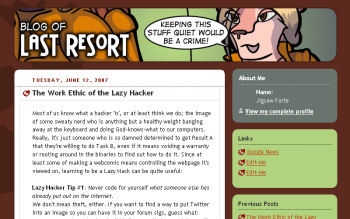
This ties back to the Lazy Hacker approach: looking for a method of 'least resistance' in order to get exactly what you want. Fortunately, the Lazy Hacker approach also lends itself to a great trick when it comes to getting noticed; by only altering the cosmetic elements of what's involved, viewers get a whole new experience even if it's the exact same everything else under the hood.

To wit: This blog is being created thanks to Blogger, and as such I grabbed one of the first templates I could think of. Actually, I ended up grabbing 'Rounders' instead because it was more grok-able than the first one I picked up.


I shouldn't have to go too far in explaining why this simply wasn't good enough for my tastes. It's a perfectly fine layout, yes, and it has nice rounded edges, which looks better than sharp corners. But the colors are all wrong (despite the header being a nice red), and if I wanted to change any of the colors, I couldn't deviate far from the presets without the corner images themselves clashing. Furthermore . . . it looked obvious it was a Blogger page. Regardless of what my readers might 'think of me' for using it, leaving it in a default setting didn't make any sense at all when it was completely different from my comic site's layout. If nothing else, it had to look like the two pages went together.

To Fix: One of the few saving graces of the fact I'd picked up an otherwise unsuitable template was that (as I mentioned) the code was quite clean in comparison to some of the other templates, and I had a general idea that the main fixes I needed to do were mostly image-based; in other words, I needed to find the image URL references in the template given, and replace them with a few of my own. To keep the amount of necessary work to a minimum, I would often reference the template images given to make sure I was on the right track with sizes and general image/page anatomy involved.


The main issue with this approach was that the template was designed to work with the specific images it had, and so where mine deviated, I had to adjust the code to make them fit. Typically this involved altering the 'padding' of the given sections and constantly hitting the 'Preview' button on the template each time I made even minor changes to see what effect I had. Obsessive, perhaps, but it worked.

Wherever something didn't fit in with the new scheme, it was "commented out" of the HTML coding, just in case I realized I wanted it for later (which is where that ugly text that was replaced by the new banner image went) . For the most part though, the actual layout of the page went untouched — the profile box barely looks different at all, although that's more by coincidence than anything else. The color DID change slightly to match the banner's edge, but that's about it.

The end goal was achieved in only a few hours' time though: We've broken free of the Blogger default, and made it look like it actually belongs to the domain. We even managed to use the favicon to replace the arrows in the bullets, adding to the design reinforcement. It's not a completed change-over, but it's sufficient enough that it's worth leaving it alone for now to see how well it actually works.

Interested in a similar redesign? Email me and we'll see if we can't arrange (or rearrange, as the case may be) something... or just subscribe to the RSS feed and stay tuned.

Labels: , , , ,