Thursday, June 26, 2008

Morning Coffee Returns! Webcomic Fans Rejoice!

For everyone who got themselves all wrapped up in Download Day 2008 and found themselves without their daily dose of Morning Coffee... good news! It's back again, and is now compatible with Firefox 3!
What the heck is Morning Coffee? It's the most awesome Firefox Add-on that you can think of for webcomics! Once you have all your comics listed within the extension, just one click of the coffee cup gets you all the comics you want to read that day!
Out of sheer joy for the new update of Morning Coffee, I've made a great how-to lens about it. It'll walk you through all the steps of how to install and set up your new extension so you never have to worry about missing webcomic updates again! I even did some screenshots for it so you know exactly what you're looking for.

If you've not heard of Morning Coffee before or tried it out, this is a great way to learn about it. Check it out!

Labels: , ,

Tuesday, February 12, 2008

Positioning Statements - Target or Die!

Comics need readers. Readers are brought in by, among other things, good advertising. This tends to require that the makers of those comics make their own advertising, and just like there are bad webcomics, there can be worse advertising for these comics. Fortunately, good advertising doesn't require big focus groups and research (at least not all the time) -- sometimes you can get away with using a tiny guideline called a positioning statement.

Positioning Statements are little blurbs of text that sound fairly useless at first -- perhaps even amazingly obvious -- but they allow you to understand who your audience is, what makes your stuff stand out, and if you're really struggling to come up with a good ad to use, this can help give you a bellwether to gauge its effectiveness by. (At this point it should go without saying that if you're paying for space on Project Wonderful without having something like this, you're probably wasting money on an ineffective ad!) For something that your average reader will probably never see, it's still incredibly important to have.

It may take a little bit of time to write the statement itself, but they all tend to follow the same sort of structure. This site has a straightforward plug-and-play version that you can go and tweak for your own purposes:
For [whoever's cash/attention we're after] that wants [some quality people demand], [Our Product/Service/Brand] is a [product category] that has [a benefit tied to the quality people demand].

Unlike [whoever we're trying to grind underfoot], [Our Product/Service/Brand] has [this trait that makes us better than them].
Now, you can rewrite that statement to sound a little less aggressive, but the idea is there. What you fill in the blanks with says a LOT about what you need to do. Heck, just to show that I have half a clue what writing such a statement will do, let's try it out with our favorite guinea pig, Last Resort:
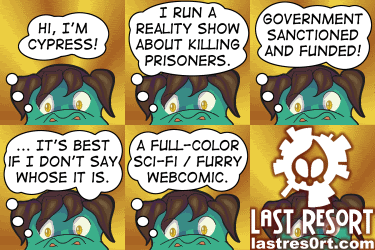
For science fantasy enthusiasts who love engrossing stories of crime and redemption, Last Resort is a webcomic that has a rich galaxy of characters, excellent writing, and action-packed excitement. Unlike most other webcomics, Last Resort makes sure to update on time every week, so you never show up to find disappointing 'filler'.
Sounds pretty awesome, right? Well guess what we just did:
  • We now know who to aim our sights on: Sci-fi/Fantasy folk (i.e. Dragon*Con Fodder)
  • We also know what to hype in the comic:
    • High-Quality Writing / Storytelling
    • Reliability in Updates
  • We can put those two together to make better targeted ads!
See? Mad Libs can be educational after all! The other things we mentioned (like our competition) are useful to know, but really, that's just so we know who to compare our egos against. Simply naming competition isn't good enough unless you know what makes you different from them; and if you can't come up with a good reason why what you're doing is different from everyone else's, there's no reason for anyone else to stop using their product to invest time, energy, and money into yours.

And yes, even when that product is a 'free' webcomic, people's attention spans are still valuable enough to them that if they're already reading 20+ webcomics a day, there's a good chance they might not have time for yours. If it has a 100+ strip archive that people need to read before they can understand what's going on, they might be even more hesitant because reading that archive is an investment of time.

Targeting solves a lot of problems; most people (artists, especially) get caught up in the product, wondering why nobody's noticing them on a giant website like DeviantArt or DrunkDuck, when in fact that's exactly why they're not getting noticed; the potential number of people to reach is just too big to be effective. With targeting, however, you can take a website like Project Wonderful and start running campaigns on very specific websites that have certain keywords, so you waste less money on ineffective advertising.

Still curious about how to make better advertising? Subscribing to the RSS feed will make sure you don't miss the next useful article. If you're having trouble coming up with a good statement, how about leaving a comment with your own ideas and attempts?

Labels: , , , ,

Saturday, January 19, 2008

One Simple Way to Generate More Money out of Project Wonderful (AKA "Why My Ads Started Getting Better")

Freshman Quad, January 19, 2008. Doesn't really have a whole lot of appeal, does it?

Sure, we kinda know what it is — probably a school space (or near a school space) of some kind, and a date. A fairly recent date. Interesting if we already had a bit of a clue, perhaps... but to the average person, it's still pretty mundane.

Freshman Quad, January 19, 2008 - Rare Snowfall at the Atlanta campus. Now this . . . we're getting somewhere. We know there's snow, in a place that doesn't normally get it. Hell, maybe people in the general area will be interested enough to see, now that they have information they didn't before.

Seem simple? Because it is.

I mention this in regards to Project Wonderful (as opposed to say, search engines like Google) because unlike most search engines / directories, most advertisers on Project Wonderful only see a few stats about your available advertising — what your stats are, what your space usually goes for, and the title of your site. Mebbe also a quick usericon that has a sample of your art, if it's worthwhile. Sure, maybe some advertisers (especially if they plan on dumping potentially hundreds of dollars into your site!) will look more closely, but not all. That makes your title one of the few things you can control regarding how advertisers view your site, and also one of the most important to get right.

The more information you have in there that seems worth having, the more it matters. In my own case, merely changing the visible title for those ad blocks from "Last Resort" to "Last Resort - Science Fiction Furry Comic" made a huge difference; by the very next day, I was seeing bids jump from 1 or 2 cents a day to THIRTY cents. Granted, I had also reduced the number of ads available on the site from two to one, so at least part of that could be due to
tightening up the purse strings, but they've been doing exceptionally well since. Also, on the blog page (which had a similar renaming on PW), prices did a similar jump there as well.

Granted, it assumes you know what you need to say to get people interested, but if you already have the site, why not give it a title that makes sure people know what you're about?

Have a better idea? Think I could possibly add something more appealing to my suggestions? Let me know!

Labels: , , , ,

Friday, December 28, 2007

Gaming Project Wonderful: Fewer Ads, Bidding Nothing Makes You More Money

When Project Wonderful first came out and approached the webcomic communities, people thought the new "Infinite Auction" model would revolutionize advertising as we know it. Finally, everyone thought, people would get paid what they were worth! Of course, nobody realized what "they were worth" actually meant.

Make no mistake, Project Wonderful is a clever system, and it's certainly more entertaining (and easier) to become an advertiser on there than ever before. The problem is that (like most advertising media), Project Wonderful is working in the Advertiser's favor, so it's up to the publishers to do everything they can to make sure their properties make as much as they can. Fortunately, it's easy to be both, and there's only a few things that need to be done to get the best results possible, to beat Project Wonderful:
  1. Comb the Freebies. Sometimes bids go for $0.00 (as in absolutely free), and believe it or not, these things will allow you to use completely free advertising. By bidding on these, you force paying customers to pony up (which does at least a little good for the people offering the space, as even 1 cent of profit is better than making absolutely nothing), and/or you get some free airtime, which drives new traffic to the site and improves your own statistics (see below). Remember, you can only make a zero bid for two days at a time, and even if someone else already had a $0 bid on the slot, that just means that you can either force them to pay, or you'll get the spot once their two days runs out.

    The best way to do this is to use Firefox to access PW, search for a specific size ad, and target the ads with a $0.00 current bid and no minimum; then open up a huge number of tabs to bid on those zero-spaces once you've pulled out a good number to bid on. At least 25% of those will likely result in immediate high bids. Even if they're on lousy sites, it's exposure nontheless, and it's also an easy way to test out similar ads against each other (which allows you to E.A.T. on your ads prior to actually laying out some cash!)

  2. Don't Be Picky. Waiting for a publisher to accept your ad is a drag, and likewise, you're missing out on money from each and every ad you do accept, because you get credited every 30 minutes! Even if you like one ad over another, keep in mind that everyone else's bids drive up the price of the one getting the top slot right now, so being picky is in nobody's best interest.

    Why? Because EVERY BID BUILDS ON THE OTHERS. Here's a quick demonstration of a typical bidding scenario on a single ad space:

    • Bidder A is willing to pay $1 on the space, but nobody else wants it. Even though A could pay, it is an unconstested bid, so A gets the slot for free, and the publisher gets no money even though A is willing to pay $1.
    • Bidder B comes along with a $0.00 bid, since he's looking for free advertising. Suddenly there are more bidders than spaces available, so bidding begins to come into play. Even though B is freeloading, it's still an active bid, and so A is finally forced to pay (it's only a cent, sure, but that's better than nothing!).
    • Bidder C comes along and bids $0.05. Now A has to pay $0.06 in order to keep C from claiming the space.

    In other words, the only way you get A to actually pay $1 is if someone bids up to $0.90 on the same slot at the same time. This is great for advertisers because it ensures they never pay more than they want to, but the only way publishers (i.e. you) get to see these huge returns is if a bidding war actually starts. Also, it means you shouldn't discourage smaller bidders, because their presence forces bidding wars and gets higher-paying advertisers to shell out more money. Bidders will often pull out when they realize they're being outbid, which is a pain in the ass in and of itself when you're counting on certain bidders to keep your prices high, so don't help the process along unless there's something REALLY wrong with a higher-rated ad than you're comfortable with.

    The best way to encourage bidding wars is to keep the number of ads available at any given time down to begin with, and that means showing the largest ads you can for a given space. Larger ads pay better (Note how the Skyscraper ad on the blog tends to outperform the banner ads on Last Resort's front page, even though the blog receives only a fraction of the traffic), and the more spaces you have, the more people you need to even be interested in advertising there to make a single cent (once again, the ads only start paying off when you have more bidders than available slots!).

  3. Expect Logarithmic Returns on Traffic. Put bluntly, there are a lot of sites with very little traffic, and very few sites that get a lot of traffic. As you accrue more traffic, you should receive exponentially higher bids for that traffic because you are now competing with fewer and fewer sites that have the same level of traffic.

    This gets back to the initial problem again of furthering your exposure, but it also means that when you start to see an improvement in ads, it also means you're getting more/better traffic as well.
Keep in mind that Project Wonderful should not be your only source of income; while more consistent than donations, it can be incredibly hard to see worthwhile returns when starting out. The good news is that Project Wonderful can run alongside Google Adsense (Google's restrictions apply only to content-based ads; Project Wonderful doesn't care about content!) , and it can provide a new set of statistics for you to keep track of, giving you a better sense of where to put your ads (and also how to further improve your advertising gain!)

And when you realize how easy that can be, it's just wonderful.

Labels: , , , , , , , , , , ,

Thursday, December 6, 2007

Project Wonderful, Google Analytics, and Experimenting with the Website

Been busy on a lot of things (not the least of which is end-of-semester prep) along with trying to figure out what else is good to do for the website. Consider this a random-dump post versus anything else.
  • Google Analytics is still in the "Well it's interesting, bot how useful is it?" category. It's one thing to know you have X% of a bounce rate, but another to understand how much any given change can reduce that rate. And while Funneling and Goals are nice, on a non-defined page that isn't really selling anything (except perhaps either donations and/or Project Wonderful ads), it's only so useful.
  • Speaking of Project Wonderful, I'm trying out some new ads by these folk, in order to take a little pressure off of the donation meter. I receive (almost) as big a percentage off of these as I do from donations, even though the current amount is still just pocket change.
  • Cast Images are coming soon (while comic pages are still needing to be done, cast images are surprisingly quick to do) ; I intend on posting them in packs of 4 at a time, due to the large number of characters we have so far (there's at least 20 'main' characters right off the bat . . . Not as many of them are visible at any given point, but that's still a huge amount of people compared to most other webcomics). In the meantime, for those looking to get a sneak preview, already-completed images are showing up at DeviantArt before they end up here. They're just the images through; the text to go with these images will arrive when they show up on the website.
Until next time, folks!

Labels: , , , , , , , ,

Thursday, June 21, 2007

5 Reasons to Love Web 2.0

A big thing I encourage when it comes to marketing tactics is to use the routes that your competition doesn't. This often gets confused for viral/guerrilla marketing, but mostly it's just inventing new ways to reach out to your audience. A lot of the time, this means using some of the new 'in' technologies of web 2.0, and here's why:
  1. New utilities mean the Older competition won't use them.
    Well, why would they? They're already popular, and a contented brand doesn't push as hard as a new one struggling to get the word out. Of course, they get more bang for their effort, so it's a trade off, but at least that's a few less people you have to worry about for your competition.
  2. New utilities are ravenous content-vores; at worst, it'll be digested quickly and forgotten faster.
    Unlike LiveJournal and other forum-type software where all your most embarrassing moments will remain displayed for eternity unless you make a concerted effort (or end up mistaken for a pedophile), bad content on 2.0 gets buried quickly under mounds of new content, if it shows up at all. Thankfully this means that unless you fail so hard it becomes infamous, you have a good chance to change your behavior and try again without much effort.
  3. The best ones are also super-easy to update, which allows you to be more regular.
    Twitter's a prime example: 140-characters-or-less posts, doable by SMS, IM, or through your computer. Basically, when you're just standing in line somewhere, you now have time to fire off a quick post. I use mine for keeping people posted on my buffer, witty one-liners, or other things I might forget later.
  4. They make you look more accessible, and accessibility is king.
    Artists tend to become more reclusive as they get bigger, which is fine for us since it means that the more accessible you are, the more likely they'll come to you even when you're not their favorite, but they still like you.
  5. You're putting out lots and lots of content for later.
    The people who will be real fans of your work will want to swarm over every single detail you already have out there; yes, it's stalker-ish, but it's true. You may as well let them get lost in your own content so they remain enamoured longer (and also to keep them satiated before they start clamoring for more)
So go ahead and try some new technologies and sites. Worst case, you wasted a little time, but in the best case, you're tapping into a whole new market.

Labels: , , , , , , ,